






Michigan Traffic Accidents by the Numbers
Car accidents don’t just happen to reckless drivers or people with bad luck. They can happen to anyone, including new drivers, young parents, and commuters with years of experience behind the wheel. It only takes a split-second for an accident to happen.
While no 2 accidents are exactly the same, most fall into clear categories, such as rear-end collisions, angle crashes, single-vehicle incidents, and sideswipes. Statewide data from 2024 Michigan Traffic Crash Facts helps us understand different types of car accidents and where the greatest risks lie.
- Michigan reported 288,880 traffic crashes in 2024.
- October is the most dangerous month for crashes with over 30,000 accidents reported.
- Approximately 236,600 accidents involved property damage only. October-January is peak season for these accidents.
- More than 51,000 injury crashes were reported in 2024. May through October have the highest number of injury collisions.
- City and county roads have the highest number of crashes (57%) followed by U.S. and state roads (30%).
- Fewer accidents (13%) are reported on interstate highways like I-96 and I-196.
- Urban areas have a higher rate of accidents. Two out of 3 crashes occur in cities like Grand Rapids.
- While just 1 in 3 accidents occurs on rural roads, 47.4% of fatal crashes occur in these areas.
1. Single Vehicle (Most Common Car Accident Type)
Single‑vehicle crashes involve one vehicle leaving the roadway or hitting an object without striking another vehicle. This includes near-miss accidents where a driver needs to swerve to avoid oncoming traffic. Single-vehicle accidents account for 105,753 incidents, or 36.6% of all collisions statewide. In 2024, there were just over 508 fatal single-car accidents, accounting for 50% of all traffic-related fatalities.
Single-Vehicle Accident Causes
- Excessive speed (noted in over 20% of fatal crashes statewide)
- Inclement weather, such as rain, snow, and ice
- Swerving to avoid animals or obstacles
- Distracted driving and lane departures
Injury Risks
Single-car accidents often lead to severe injuries, including head trauma, broken bones, and organ damage.
Legal Challenges
It’s harder to pursue compensation for single-vehicle crashes in civil court because it’s difficult to prove that another driver caused the accident due to negligence, recklessness, or impairment. The outcome often depends on witness statements and police reports.
2. Rear‑End Collisions
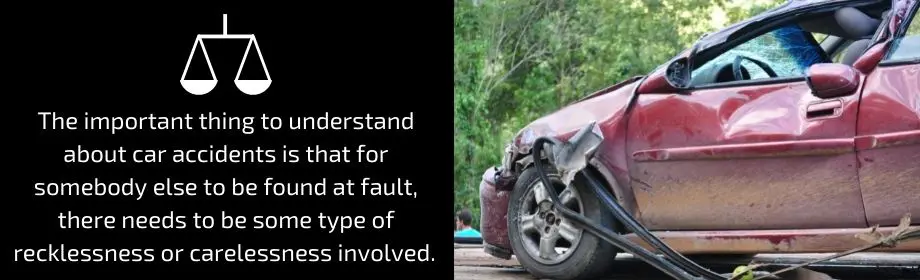
Rear-end collisions are the second-most common type of car accident in Michigan. These crashes occur when 1 vehicle collides into the back of another. They often happen at traffic lights, in stop-and-go traffic, or when a driver fails to notice a sudden slowdown.
Over 62,700 rear-end collisions are reported annually, which equates to about 22% of all wrecks statewide. Fortunately, about 80% of rear-end collisions involve property damage only. Rear-end accidents can also occur during turns although these are far less common.
Rear-End Collision Causes
- Following too closely
- Distracted driving (e.g., phone use)
- Sudden stops
- Bumper-to-bumper traffic
Injury Risks
Whiplash and back/neck strains are associated with rear‑end collisions, even at low or moderate speeds. Rear-end accidents account for 5.6% of fatal accidents, especially at high speeds.
Legal Challenges
In Michigan, courts and insurers typically presume that the following driver is at fault unless unusual circumstances are shown.
3. Angle (T‑Bone) Accidents at Intersections
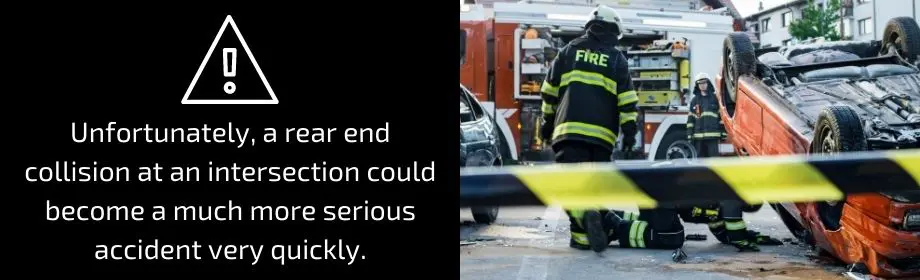
Angle crashes, also called broadside accidents, occur when one driver hits the side of another vehicle, forming a perpendicular L or T shape. This is most common at intersections like U.S. 131 at Burton Street, but it can also occur near driveways or parking lot entrances where vehicles frequently cross paths.
In Michigan, about 44,500 T-bone collisions are reported annually. Angle accidents account for 15.4% of all collisions and 17.9% of fatal accidents. Complex traffic patterns, dangerous roads, and conflicting signal phases increase the risk of intersection accidents. In fact, nearly 1 in 3 fatal accidents occurs at an intersection.
Angle Accident Causes
- Failure to yield
- Running a red light or stop sign
- Distracted driving
- Misjudging oncoming traffic
- Turning in front of another vehicle
Injury Risks
Side-impact collisions can result in severe injuries, including head and chest trauma, pelvic injuries, and organ damage. Vehicles often have less protection on the sides, which makes these accidents more dangerous than front- or rear-impact collisions.
Legal Challenges
Proving liability can be more challenging in angle collisions since both drivers may claim that they had the right-of-way. Inconsistent police reports or biased testimony from passengers can complicate matters. Disputes may require dashcam footage or physical evidence to resolve.
4. Sideswipe Accidents
Nearly 44,000 sideswipe crashes are reported annually in Michigan. Same-direction accidents are much more common, accounting for 13.4% of traffic collisions, while opposite-direction sideswipes account for less than 2% of all traffic accidents. The majority of these accidents involve property damage only, but injuries and fatalities are also possible.
Sideswipe Accident Causes
- Unsafe lane changes
- Failing to check blind spots
- Distracted driving and lane departures
- Impaired or drowsy driving
- Improper merging
- Road rage and weaving through traffic
Injury Risks
Many sideswipe accidents result in property damage only. However, severe injuries, such as broken bones, spinal cord damage, and whiplash, are possible. Injuries often occur due to secondary collisions after the initial impact, such as rollovers or striking a guardrail or nearby vehicle.
Legal Challenges
Proving fault after a sideswipe accident can be difficult. There may be limited physical evidence, and it can be hard to determine which driver changed lanes improperly, resulting in a he said, she said dispute. Liability is also more complex in multi-vehicle accidents.
5. Head-On Accidents
Head-on accidents and left-turn collisions are not common, but they are more likely to be deadly. About 10,500 head-on accidents are reported annually (3.6% of all accidents), this includes about 7,300 left-turn collisions and 3,200 front-impact accidents. Sadly, these accidents account for 17.6% of fatal traffic collisions, especially when impacts occur at high speeds.
Head-On Accident Causes
- Crossing the center line
- Wrong-way driving on divided highways or ramps
- Improper passing
- Impaired driving
- Loss of control
- Weather-related conditions
Injury Risks
Even with airbags and seatbelts, head-on collisions are more likely to be fatal. Drivers and passengers may experience head injuries, spinal cord damage, broken bones, and internal bleeding.
Legal Challenges
Head-on accidents sometimes involve disputes about visibility and roadway design or signage. If one driver was impaired, they are presumed to be at fault. It can also be difficult to determine who crossed the center line without video evidence or credible witness statements.
6. Backing & Parking Lot Accidents
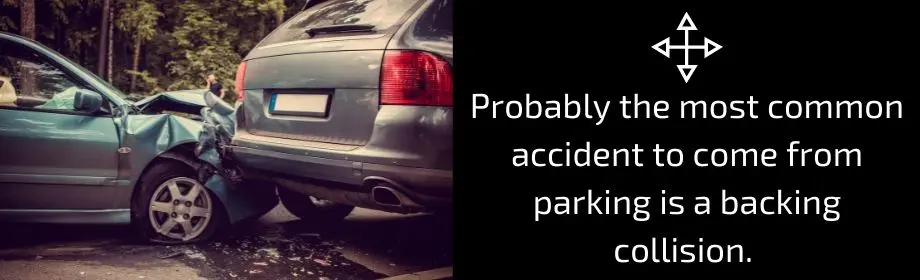
Low‑speed crashes often occur in parking areas or when reversing. Drivers who are backing may strike an oncoming vehicle or pedestrian. Vehicles can also be struck while parked on the street or in a parking garage or other designated area. Hit-and-run incidents are common if one vehicle was unattended. Without witnesses or camera footage, identifying the responsible party can be challenging.
Fortunately, the vast majority of backing accidents (97%) involve property damage only since impacts typically occur at low speeds. Overall, backing accidents represent just 2.3% of all traffic collisions.
Backing Accident Causes
- Blindspots
- Rushed or distracted driving
- Lack of backup cameras
- Poor lighting and visibility
- Improper lookout
Injury Risks
Vehicle occupants may experience whiplash and minor soft-tissue injuries. Pedestrians and bystanders are more likely to be affected by severe injuries if they are hit or fall trying to avoid the impact. Children are particularly vulnerable to backing accidents as the driver may not be able to see them.
Legal Challenges
Determining liability often hinges on who initiated the backing maneuver and visibility-related factors. If liability is unclear, it’s worth discussing your case with a car accident lawyer to determine who is at fault.
What Kind of Support Do You Need After a Car Accident?
A car accident can have many legal, financial, and health-related ramifications. A lawyer can help you understand your rights and guide you through the claims process.
Medical Care
Seek medical attention immediately after the accident, even if your injuries seem minor. A doctor can rule out serious conditions like concussion or internal trauma and provide documentation confirming your injuries.
Legal Support
Working with a Grand Rapids car accident attorney is helpful for gathering evidence, including police reports, witness statements, and surveillance footage, needed to prove your side of the story. Lawyers can handle all communication with the insurance company while ensuring that your claim is fairly valued.
Financial Help
An accident can leave you with substantial medical bills and vehicle repair costs. Even if your insurance covers the claim, you may be on the hook for the deductible and other out-of-pocket costs. An attorney can help you negotiate payment or seek compensation from the at-fault driver.
When to Contact a Michigan Car Accident Attorney
Michigan’s no-fault insurance system is designed to simplify the claims process, but it can actually make things more complex, especially if you need to sue the at-fault driver for excess damages that aren’t covered by insurance. Consider speaking with a lawyer if:
- You or a loved one suffered injuries.
- Fault is disputed or unclear.
- The insurer has denied or delayed your claim.
- The other driver was uninsured or underinsured.
- You received a settlement offer but don’t believe it’s fair.
If you or someone you love has been hurt in a car accident, you may be entitled to compensation for your injuries, vehicle damage, and other losses. At Barrix Law Firm, we’ve spent over 30 years helping injured drivers across West Michigan recover what they deserve. We understand Michigan’s complex no-fault insurance system and know how to hold insurers accountable. Contact us now to request your free, no-obligation case review.