







Common Causes of Michigan Motorcycle Accidents
Most motorcycle accidents happen because someone makes a preventable mistake. In Michigan, those mistakes often involve drivers who fail to see motorcycles, fail to yield, make unsafe turns, or don’t leave riders enough room.
Some crashes are caused by riders. Others involve road hazards, poor weather, vehicle defects, or several contributing factors at once. But many serious motorcycle accidents come back to negligence. If any of the following causes sound like what happened to you, speak with a Michigan motorcycle accident lawyer to find out how you can pursue compensation.
Drivers Failing to See Motorcycles
This cause occurs when motorists look out for oncoming traffic but completely fail to register smaller, narrow vehicles like motorcycles in their path—a psychological phenomenon known as “inattentional blindness.” NHTSA notes that the majority of multi-vehicle motorcycle crashes are generally caused when other drivers simply did not see the motorcyclist (NHTSA, 2024).
This condition is exceptionally dangerous because if a driver doesn’t see a rider, they will proceed with maneuvers like lane changes or intersection crossings without braking. This leads to full-impact, abrupt collisions that leave riders with absolutely zero time to take evasive action.
Left-Hand Turns
A left-turn accident happens when a motorist turns left at an intersection, median, or driveway directly across the path of an oncoming motorcycle that legally has the right-of-way. In 46% of all fatal two-vehicle motorcycle crashes, the other vehicle was turning left while the motorcycle was traveling straight, passing, or overtaking (NHTSA, 2023).
These accidents are lethal for riders because drivers routinely misjudge the speed and distance of a smaller vehicle. Because a left-turn crash usually results in a direct, perpendicular T-bone collision, the rider is typically thrown violently over the vehicle’s hood, leading to catastrophic or fatal bodily trauma.
Failure-to-Yield Crashes
Failure-to-yield occurs when a driver ignores traffic signals, rolls through stop signs, or violates right-of-way laws, pulling out directly in front of an approaching motorcycle. In Michigan traffic crash records, “failure to yield” is consistently documented as the leading driver hazardous action in multi-vehicle crashes involving motorcycles.
This behavior is incredibly dangerous for motorcyclists because motorists typically scan the road only for large objects like SUVs or commercial trucks. When a driver pulls out and steals a rider’s right-of-way, the lack of an external vehicle frame means the rider absorbs 100% of the physical energy of the impact.
Unsafe Lane Changes
An unsafe lane change happens when a driver moves their vehicle from one lane to another without signaling, checking their mirrors, or properly looking over their shoulder to ensure the lane is clear. Multi-vehicle crash data indicates that lane-change violations make up roughly 5% to 10% of highway motorcycle collisions.
Because motorcycles have a much smaller visual profile, they can easily disappear between lane markings. When a driver merges haphazardly, they risk sideswiping a rider at highway speeds or forcing them off the asphalt into concrete barriers, which almost always results in a violent ejection from the bike.
Blind Spots
Blind spots are the areas around a vehicle that cannot be directly observed by the driver while looking through standard rearview or side mirrors. Larger consumer vehicles like SUVs, vans, and pickup trucks have blind spots that are often larger than standard sedans, heavily escalating the risk for nearby riders.
Motorcycles are narrow and compact, meaning they can easily fit entirely inside a vehicle’s blind spot. If a driver fails to physically turn their head to check over their shoulder before moving, they can crush or clip an adjacent rider without ever realizing they were sharing the space.
Speeding
Speeding involves operating a vehicle or motorcycle above the posted speed limit or traveling too fast for current road, traffic, or weather conditions. In 2021, 33% of motorcycle operators involved in fatal crashes were speeding (NHTSA, 2021), compared with 22% of passenger car drivers. Speeding gives drivers and riders less time to react and increases the force of impact when a crash happens.
Excessive speed reduces the amount of time a driver has to react to a sudden hazard and exponentially multiplies the kinetic energy released during an impact. For an unprotected rider, higher speeds directly translate to severe, life-altering internal injuries or instant death upon contact with a vehicle or the pavement.
Distracted Driving
Distracted driving is any activity that diverts a driver’s attention away from the primary task of operating their vehicle, including texting, using navigation systems, eating, or adjusting the radio. Distracted driving was involved in 3,208 deaths in 2024 (NHTSA, 2024). And in 2023, 8% of fatal crashes were reported as distraction-affected (this link is a PDF file download: NHTSA, 2023).
Motorcycling requires extreme defensive awareness and constant lane adjustments. When a driver is staring at a smartphone screen, they are effectively driving blind for several seconds, meaning they will completely fail to notice a braking or turning motorcycle until a catastrophic collision is entirely unavoidable.
Loss of Control
Loss of control occurs when a rider can no longer safely steer, balance, or brake, causing the motorcycle to slide, leave the roadway, strike a fixed object, or crash. NHTSA data shows that single-vehicle crashes accounted for about 36% of motorcycle rider fatalities in 2023, with 2,171 riders killed in single-vehicle crashes compared with 3,854 riders killed in multi-vehicle crashes. These crashes may involve speed, impairment, curves, road hazards, mechanical problems, or sudden evasive maneuvers (NHTSA, 2023).
Unlike passenger cars, which remain stable on four wheels if they slide, a motorcycle requires continuous balance and perfect physics. Even a minor over-braking error or brief loss of tire traction will cause a bike to immediately slide out (“low-side”) or violently flip the rider into the air (“high-side”).
Following Too Closely
Commonly known as tailgating, this cause involves failing to maintain a safe, legal buffer distance between your vehicle and the vehicle directly ahead of you. Rear-end collisions account for a massive percentage of urban traffic accidents, and tailgating is the leading cause behind these sudden chain-reaction crashes.
Motorcycles can brake and come to a complete stop much faster and in shorter distances than massive passenger cars or commercial trucks. If a driver tailgates a rider and the rider has to brake suddenly for a hazard, the trailing vehicle will inevitably plow into the back of the bike, crushing the rider from behind.
Alcohol and Drug Impairment
Impairment involves operating a motor vehicle or motorcycle while under the influence of substances that degrade cognitive function, vision, coordination, and physical reaction times. Nationally, 41% of motorcycle riders who died in single-vehicle crashes were alcohol-impaired, compared with 18% of riders who died in multi-vehicle crashes (NHTSA, 2023). Impairment can make it harder for a driver or rider to judge speed, spot hazards, stay in the correct lane, and react in time to avoid a crash.
Road Hazards: Potholes, Gravel, and Construction Zones
Road hazards consist of physical pavement deficiencies, loose debris, or temporary lane shifts that compromise the integrity of the driving surface. According to Michigan crash analytics, rough pavement and surface debris are cited as environmental factors in thousands of single-vehicle motorcycle spills, especially following the state’s severe spring freeze-thaw cycles.
A pothole, a patch of loose gravel, or a slick construction plate that a standard passenger car passes over with a minor bump can be completely fatal for a motorcycle. Because bikes rely on two tiny patches of tire contact for traction, hitting these hazards can instantly jar the handlebars or cause the front tire to wash out, throwing the rider off the bike.
Weather and Low-Visibility Conditions
This category includes inclement weather conditions such as heavy rain, dense fog, snow, or nighttime darkness that reduce road traction and driver sightlines. Although the vast majority of motorcycle accidents happen in daylight, the fatality rate per crash increases significantly during nighttime hours and rainstorms.
Rain creates slick pavement and causes lane-marking paint to become as slippery as ice, drastically cutting down a motorcycle’s braking efficiency. When paired with reduced visibility from fog or darkness, drivers become even less likely to spot a rider, turning routine roadways into a landscape of unseen hazards.
Motorcycle Defects or Mechanical Failures
Mechanical failure involves the sudden malfunction of a critical bike component—such as brake failure, a tire blowout, or steering alignment issues—due to manufacturing defects or improper maintenance. While mechanical failure accounts for less than 3% of overall traffic accidents, it carries a vastly higher injury rate when it happens to a two-wheeled vehicle.
If a car suffers a tire blowout, the driver can usually coast safely to the shoulder on three remaining wheels. If a motorcycle experiences a front-tire blowout or a sudden brake failure at highway speeds, the mechanical instability will immediately cause a violent, unrecoverable wreck that leaves the rider entirely helpless.
Why Does It Help to Know What Caused My Motorcycle Accident?
Identifying the cause matters. The cause of the crash can affect:
- Who may be legally responsible
- Which insurance policies may apply
- Whether the injured rider can recover compensation
- Whether more than one party may share fault
- How the insurance company may try to defend the claim
A motorcycle crash report may list the crash type, but that doesn’t always tell the full story. A crash labeled as a single-vehicle accident may still involve another driver, a road hazard, or a dangerous condition that forced the rider to react. A crash blamed on speed may also involve a driver who failed to yield or changed lanes without checking for the motorcycle.
Michigan Motorcycle Accident Statistics
Michigan motorcycle accidents are less common than passenger vehicle crashes, but they are far more likely to cause serious or fatal injuries. Recent Michigan crash reports show that motorcycle crashes continue to cause a significant number of deaths and injuries each year. Here we’ll look at data from the most recent Michigan motorcycle crash reports to get a better understanding of how these accidents impact riders in our state.
How Many Motorcycle Accidents Happen in Michigan Each Year?
Michigan reports thousands of motorcycle-involved crashes every year. While the total number shifts slightly from year to year, the pattern is consistent: motorcycle crashes make up a small percentage of all crashes, but they cause a high number of injuries and deaths.
Recent Michigan motorcycle crash data shows:
| Year | Motorcycle-Involved Crashes | Motorcyclists Killed | Motorcyclists Injured |
| 2021 | 3,175 | 166 | 2,526 |
| 2022 | 3,158 | 173 | 2,466 |
| 2023 | 3,056 | 165 | 2,394 |
| 2024 | 3,187 | 168 | 2,460 |
(MTCF Motorcycles Annual Fact Sheets, 2021, 2022, 2023, and 2024)
How Dangerous Are Motorcycle Crashes Compared With Other Crashes?
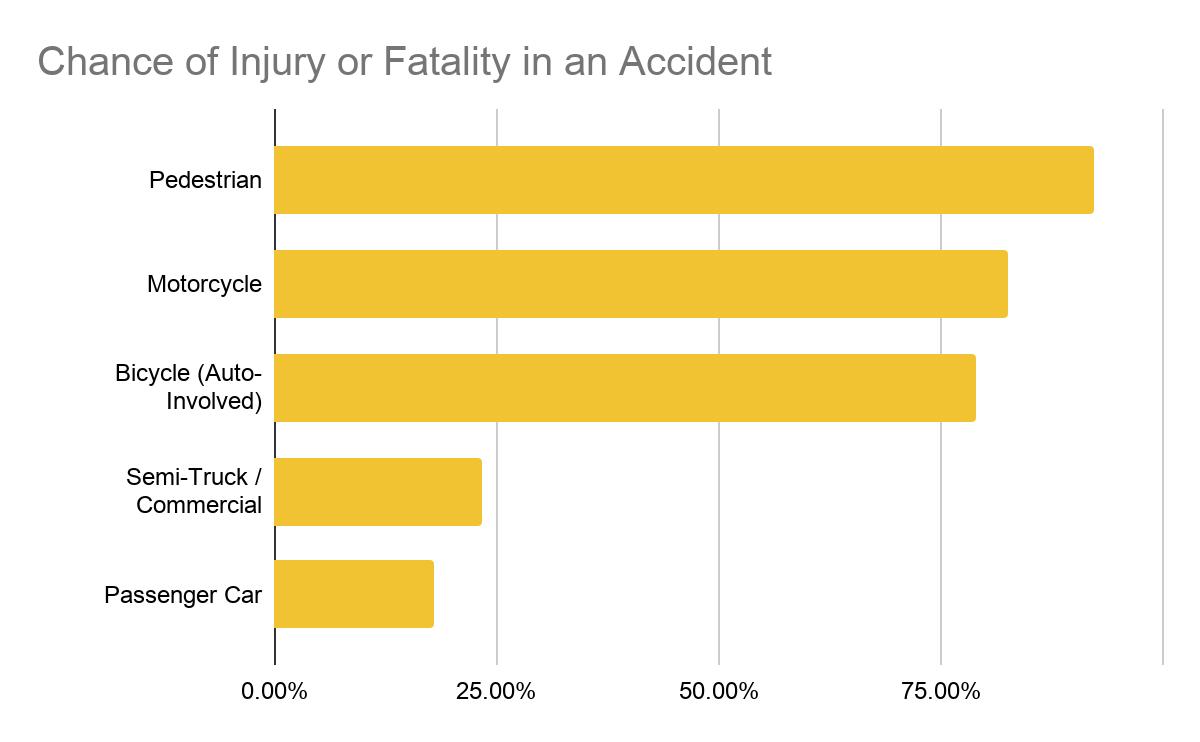
Motorcyclists, along with pedestrians and bicyclists, are classified as Vulnerable Road Users (VRUs). Because riders lack the protection that passenger vehicles have, they are at much greater risk of serious injuries. In Michigan, nearly 77.2% of all motorcycle accidents result in injury, while 5.3% result in death. Compared to car accidents, where only around 17.7% of crashes involve physical injuries (Michigan Traffic Crash Facts, 2024).
As another comparison, nearly 4 out of 5 car accidents are minor fender benders where the worst thing that people walk away with is insurance paperwork. But for motorcyclists, more than 4 out of 5 crashes end with a trip to the emergency room or worse (Michigan Traffic Crash Facts, 2024).
Comparing the Chances of Getting Injured
When we look at the raw probability of getting hurt in a police-reported accident, the gap between protected vehicles and unprotected road users becomes a chasm:
How Serious Are Injuries Caused by Motorcycle Accidents?
Motorcycle accidents are much more dangerous for riders than for other motorists. Because motorcycles lack a protective structure, crumple zones, or seatbelts, riders are completely exposed to life-changing or life-threatening injuries—even in low-speed collisions.
According to the latest Michigan Traffic Crash Facts annual report, minor “fender benders” simply don’t exist for motorcyclists. When a bike is involved in a crash, physical trauma is the overwhelming result.
Because of this extreme vulnerability, even non-fatal motorcycle collisions frequently result in severe, catastrophic injuries. Common trauma documented in these crashes includes:
- Traumatic brain injuries (TBIs)
- Spinal cord injuries and paralysis
- Complex bone fractures
- Severe road rash and skin graft requirements
- Internal bleeding and organ damage
- Traumatic amputations
What Percent of Motorcycle Accidents Result in Injury or Death?
While traffic patterns, vehicle registrations, and weather conditions fluctuate from year to year, the likelihood of a rider getting hurt in a crash in Michigan remains terrifyingly constant. Looking at a multi-year snapshot of state crash data shows that the extreme risk of motorcycle riding is far too consistent. Tracking these accidents over time reveals that a rider’s chance of walking away from a collision completely uninjured is rare.
The historical data breaks down as follows, including the finalized figures for 2024 to complete the picture:
| Year | Motorcycle-Involved Crashes | Motorcyclists Killed | Motorcyclists Injures | Combined Harm Rate (Injury or Death) |
| 2021 | 3,175 | 166 | 2,526 | 84.8% of crashes |
| 2022 | 3,158 | 173 | 2,466 | 83.6% of crashes |
| 2023 | 3,056 | 165 | 2,394 | 83.7% of crashes |
| 2024 | 3,187 | 168 | 2,460 | 82.5% of crashes |
(MTCF Motorcycles Annual Fact Sheets, 2021, 2022, 2023, and 2024)
When Are Motorcycle Crashes Most Likely to Happen?
The three highest-risk times for riders are the summer, the weekend, and the afternoon rush hour. Why these times? It’s not that deep. It’s all about volume. These are the times when not only more riders, but more motorists are on the roads.
| Time Factor | Most Dangerous Window | Why the Risk Spikes |
| Month of the Year | July & August | Peak riding season means maximum exposure and more bikes on the road. |
| Day of the Week | Saturday & Sunday | Increased volume of recreational riders sharing roads with weekend travelers. |
| Time of Day | 3:00 PM – 5:59 PM | Commuter rush hour creates high traffic density, sudden lane changes, and driver distraction. |
(MTCF, Motorcycle-Involved Crashes in Michigan 2019-2023)
Motorcycle Helmet and Safety Gear Statistics
When it comes to surviving a motorcycle crash, safety gear is the only line of defense a rider has. Because motorcycles lack structural barriers to absorb impact, safety equipment and significantly mitigate the severity of potential injuries.
Helmet Effectiveness
A DOT-compliant motorcycle helmet is the single most effective piece of safety equipment a rider can own.
- Fatality Reduction: Helmets are 37% effective at preventing fatal injuries for motorcycle operators and 41% effective for passengers (National Safety Council Motorcycle Helmet Analysis).
- Brain Injury Prevention: Helmets are 67% effective at preventing traumatic brain injuries (TBIs) (NHTSA Brain Injury Protection Study). Crash data shows that unhelmeted riders are 3 times more likely to suffer severe brain trauma than those wearing a helmet (IIHS-HLDI Motorcycles).
State Helmet Laws Improve Safety
Helmet usage shifts dramatically depending on local legislation. In states like Michigan, which features a partial helmet law (allowing riders over 21 to opt out if they meet specific licensing and insurance criteria), the data highlights a clear safety gap:
- The Fatal Disparity: In states without universal helmet laws, 54% of motorcyclists killed in crashes were not wearing helmets. In contrast, in states with universal helmet laws, only 11% of fatally injured riders were unhelmeted (this link is a PDF file download: NHSTA, 2022 Data – Motorcycles).
- National Usage Trends: On average, national daylight observations show that 73.8% of all riders utilize DOT-compliant helmets. However, in states requiring universal usage, that number jumps to 82.7%, compared to just 65.9% in partial-law or no-law states (NHTSA Motorcycle Helmet Use in 2023).
Abrasion and Road Rash Protection
Specialized gear provides vital, highly specific physical defense. A clinical registry study evaluated exactly how different apparel choices impact real-world crash trauma (Effectiveness of protective clothing for motorized 2-wheeler riders):
- 72% Less Upper Body Trauma: Wearing a motorcycle jacket and gloves together slashes the risk of soft tissue injuries (like severe road rash and lacerations) by 72%. However, this protection applies strictly to surface wounds, not deep bruising or internal contusions.
- 57% Fewer Foot & Ankle Fractures: Standard riding apparel does not significantly reduce the risk of joint dislocations or broken bones, with one major exception: dedicated riding boots cut the risk of severe foot and ankle fractures by 57%.
The Visibility Problem
A major contributing factor to multi-vehicle motorcycle wrecks is that drivers simply fail to spot smaller vehicles. Despite this risk, observational surveys show that only about 3.6% of motorcyclists routinely wear high-visibility or reflective safety gear while riding, leaving them heavily exposed to “inattentional blindness” from nearby motorists (Michigan Office of Highway Safety Planning Direct Observation Survey, 2017).
Who May Be Liable for a Michigan Motorcycle Accident?
The cause of a motorcycle accident often determines who may be legally responsible for the rider’s injuries. While another driver is frequently at fault, liability can sometimes extend to businesses, government agencies, manufacturers, or even multiple parties.
Potentially liable parties may include:
- Negligent drivers
- Drunk or drug-impaired drivers
- Commercial drivers and their employers
- Government entities or road maintenance contractors
- Vehicle or motorcycle part manufacturers
- The motorcyclist
Motorcycle accidents aren’t always caused by a single mistake, so multiple parties can be found at fault in a crash. The more parties involved in an accident, the more complicated it can be to determine fault. And when it comes to insurance companies, you can be assured they’re looking for the option that will let them keep the most money.
Contact Barrix Law Firm for a Free Case Review
Whether your crash was caused by a negligent driver, an impaired motorist, a road hazard, or another factor, understanding your legal options is an important first step. A motorcycle accident attorney in Michigan can help you navigate the challenges that come after a crash.
If you or a loved one has been injured in a motorcycle accident, contact Barrix Law Firm today for a free case review. We can answer your questions, explain your options, and help you determine the best path forward.